
The short answer
Facebook ads for contractors suit deck builders because a deck job is large enough to justify the ad. They work when the ad shows real finished decks, offers one clear next step and every enquiry gets a fast answer. Siteline Deck and Rail's Meta account recorded $58,756.00 in closed work on $1,644.39 of spend, 1 June to 31 July 2026.
In this article
- Do Facebook ads work for deck builders?
- What did Facebook ads do for a real deck and rail company?
- Is the $438,880 figure from ads?
- What should a deck builder’s Facebook ad actually show?
- How should a deck builder set up targeting and the offer?
- What happens after someone sends an enquiry?
- What should a deck builder track?
- When should a deck builder not run Facebook ads?
- Common questions
- Run the numbers for your own deck business
Do Facebook ads work for deck builders?
They can, and the reason is the size of the job. An ad costs the same whether the person who clicks wants a $300 repair or a full deck with aluminum railing. Rega’s own rule is that ads make sense when the average job is at least $2k to $3k, and deck and rail work usually clears that with room to spare. A deck builder who closes one extra job a month from ads has a different maths problem than a business selling small jobs.
The other reason is how people buy a deck. Nobody searches for one the way they search for a burst pipe. They scroll past a photo of a neighbour’s new deck, or start thinking about one in March, and only later ask for a quote. Facebook and Instagram reach that person while the idea is still forming, which is the part Google search cannot do. If you are weighing the two, we compare the two platforms side by side in a separate article.
Ads are not the answer for every deck business. They do not fit a crew that is already booked solid with no capacity to take more, a business without a phone that gets answered, or one that has no photos of finished work. The rest of this article assumes none of those is true.
What did Facebook ads do for a real deck and rail company?
Siteline Deck and Rail, a deck and railing company in Nanaimo, BC, is a Rega client, and its Meta ad account is the clearest record we have. These are the two windows we have captured, stated exactly as the dashboard shows them.
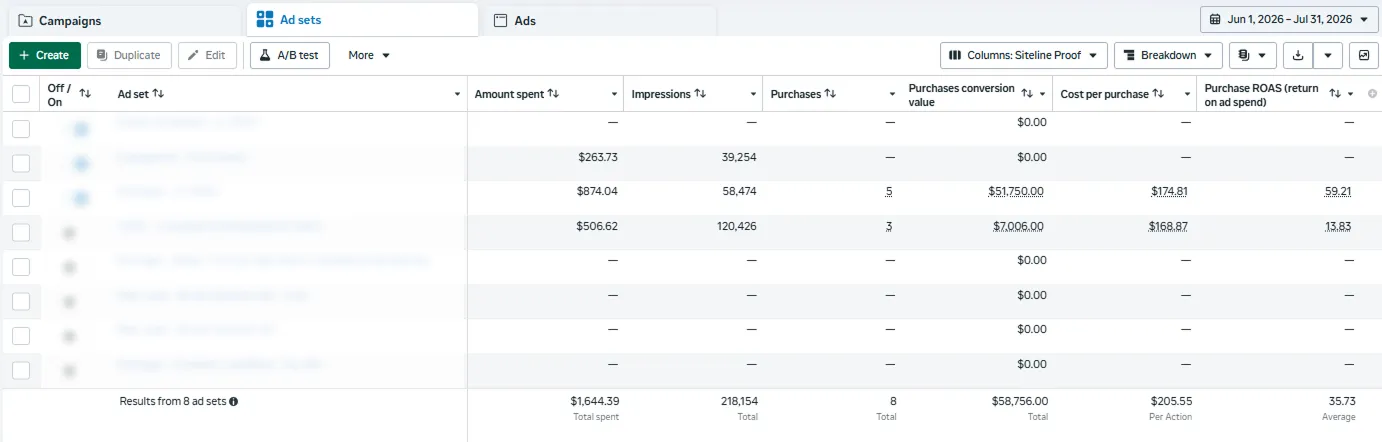
1 June to 31 July 2026. $1,644.39 spent, 218,154 impressions, 8 purchases, $58,756.00 in conversion value, $205.55 cost per purchase, and a 35.73 return on ad spend.
17 September to 16 October 2025. 8 ad sets, $900.96 spent, 86,059 impressions, 4 purchases, $42,611.50 in conversion value, $225.24 cost per purchase, and a 47.30 return on ad spend.
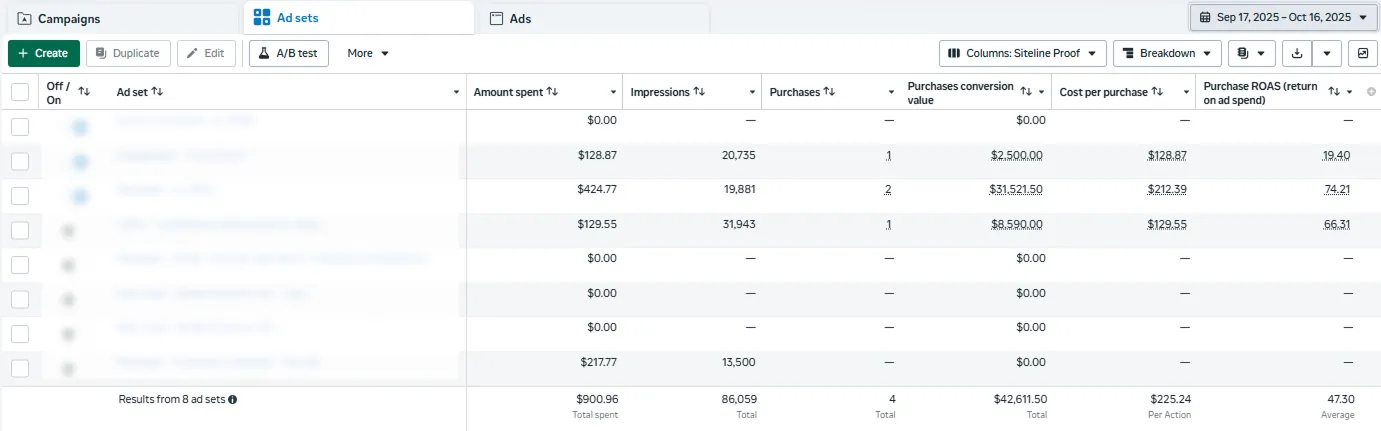
Conversion value here means closed work, not form fills or quotes issued. Return on ad spend is that closed work divided by what was spent on the ads, so 35.73 means about $35.73 of closed work for each dollar spent in that window. Both captures are published on our Facebook ads page.
Two limits on how to read these. They are two windows from one business, not an average, and they are not a forecast of what your account will do. Results depend on your offer, your market, your capacity and how fast you follow up, and no lead count, sales figure or return is promised here or anywhere on this site.
Is the $438,880 figure from ads?
No, and it is worth being exact about it. Siteline sold $438,880 in 90 days, and that came from the website, the brand, the ads and the follow-up system working together, built from the ground up. We do not credit it to ads alone, and a deck builder should not expect ads to do that on their own.
Brandon Lawson, co-owner of Siteline, describes the start this way: “When we started, we had minimal branding and no real marketing plan.” The ads were one piece of a set. A person who clicks an ad and lands on a site that looks thin, or sends an enquiry that sits unanswered for a day, is an ad dollar wasted. What a deck builder’s site needs is covered in what a deck builder’s site needs.
What should a deck builder’s Facebook ad actually show?
Show a finished deck from a real job, and say what the next step is. Finished photos of your own work do more than any copy, because the person scrolling is deciding whether your work looks like the deck they picture. Stock photos of a generic backyard do the opposite, and homeowners can tell.
Pick one job type per ad. A new composite deck build, a railing replacement, and a rotted deck repair attract different people with different budgets, and an ad that tries to cover all three speaks clearly to none. Run separate ad sets for each so you can see which one is bringing closed work.
Name the town or region you serve and keep the ad’s promise small and true: a design consult, a site visit, a quote on a set date. Do not promise results or timelines you cannot control. The ad’s only job is to start a conversation with a homeowner who is seriously considering the work.
How should a deck builder set up targeting and the offer?
Start with your real service area and homeowners, and keep the audience wide enough for Facebook to learn from. A very narrow audience gives the ad account little to learn from. Location and homeowner status do most of the work for a local trade, and the creative does the rest.
The offer is where most deck ads lose people. “Get a free quote” is what every competitor says. A specific next step works better: book a design consult, send photos of your yard for a ballpark, or pick a build slot for the season. Send people to a page that matches the ad, not to your homepage, and keep the form short enough to fill in on a phone.
Timing matters more for decks than for most trades. Demand is seasonal in most of Canada, and a build that starts in spring has to be quoted and signed well before. Plan ads for the months before you want the crew working, not the month you run out of jobs.
What happens after someone sends an enquiry?
This is where the money is won or lost. A homeowner who fills in a deck enquiry may well have asked other builders too, and a quick, clear answer is the easiest way to be the one they talk to. Answer by phone or text as fast as your day allows, and set up an automatic text that goes out even when you are on a roof. If your leads go quiet anyway, here is why Facebook leads don’t answer.
The follow-up at Siteline was built as a system rather than left to memory: estimator quote forms, appointment notifications, missed-call text-backs, automated follow-ups and pipeline tracking. Deck quotes are large and take time to decide, so most are lost to silence rather than a no. A quote that is sent and forgotten has nothing working for it, so plan a polite follow-up a few days later. Our lead system page covers how that is set up.
What should a deck builder track?
Track closed jobs against the ad that produced them, not just leads. A cost per lead tells you how cheaply people filled in a form. It does not tell you whether any of them built a deck. Siteline’s dashboard figures above are useful because the value is closed work, which means the account can show dollars against spend.
To do that you need to record the source on every enquiry, mark the ones that become jobs, and feed the value back to Meta. Without that, you will optimize for whoever fills in a form most easily, and those are often the people least likely to buy. Review it monthly: which ad and which job type produced closed work, and which only produced enquiries.
When should a deck builder not run Facebook ads?
Skip them if you cannot take on another job in the next few months, if most of your work is small repairs under a couple of thousand dollars, or if nobody reliably answers the phone. Ads add demand. They cannot add capacity or fix a slow response, and they will make both problems louder.
It is also worth waiting if you have no photos of finished work, because the ad has nothing real to show. A weekend spent photographing your last five decks is a better first step than any ad spend.
Common questions
Do I need a website before running Facebook ads? You need somewhere credible for the click to land. That can be a simple page, but it has to look like a real company with real work, and it has to work on a phone. Siteline’s ads ran alongside a built website, not instead of one. Our contractor website design page explains what that involves.
Should I boost posts instead? Boosting a post puts money behind whatever you last posted. A campaign built for enquiries lets you choose the offer, the audience and the page the person lands on, and it lets you measure closed work.
How much should I spend? It depends on your average job, your margin and how many jobs you can take on. We do not give a single number, because one that fits every builder would be invented. We explain how to work it out in how much a contractor should spend on Facebook ads. Use the calculator at the end of this article with your own job value.
Can Rega guarantee how many jobs I will get? No. No one can guarantee results from ads, and we do not. What we can do is show you the account, the tracking and what each dollar returned in a stated window, like the two above.
Run the numbers for your own deck business
Use the ad calculator on our Facebook ads for contractors page with your own job value to see what ads would need to return for your business. It makes no promise about results, and it is the quickest way to tell whether ads are worth a proper look.