
The short answer
Facebook ads for contractors have no budget that fits every business. Work backwards from your average job value, your margin and how many extra jobs you can take on each month, then test what a closed job costs. Ads only make sense above roughly a $2k to $3k average job.
In this article
- Is there a standard Facebook ad budget for contractors?
- Should a contractor run Facebook ads at all?
- How do you work out a Facebook ad budget from your own numbers?
- Why is cost per lead the wrong number to budget on?
- What did Facebook ads cost and return for a real contractor?
- What do those numbers say about budget?
- Should you start small or spend big?
- Does a contractor need a website before spending on ads?
- Common questions
- Run the numbers for your own business
Is there a standard Facebook ad budget for contractors?
No, and any article that hands you one is guessing. A plumber selling $400 repairs, a deck builder selling $25,000 builds and a septic company selling $18,000 systems are not the same maths problem, even though all three can open the same ad account. The budget that makes sense for you comes from three things you already know: what a job is worth, what you keep from it, and how many more jobs your crew can take.
So this article does not give a dollar range. It shows how to work out your own number, and then what one real account recorded so you can see the shape of the thing. Every figure from a real account is quoted as its dashboard shows it, and none of them is a target for your account.
Should a contractor run Facebook ads at all?
Only if the average job is large enough to pay for the ad. Rega’s own rule is an average job of at least $2k to $3k, ideally with a real share of jobs at $5k to $10k and up. Below that, the cost of winning a customer through ads eats too much of what the job earns. If you are also weighing Google, see how the two platforms compare.
It also depends on capacity. Ads create enquiries, and they cannot create crew time. If you are booked solid for the next four months and have no plan to hire, more demand just makes the phone louder and the waiting list longer.
And it depends on the phone. If enquiries sit for a day before anyone answers, the money spent on the ad is spent on someone who will call the next company. Fix that before you raise a budget.
How do you work out a Facebook ad budget from your own numbers?
Start with what one closed job leaves you, then decide what you would pay to win it. Multiply that by the number of extra jobs you want each month, and you have a monthly figure you can defend. It takes four steps.
- Average job value. The revenue from a typical job, not your best one.
- Gross profit per job. What is left after materials, labour and subs. This is the number that pays for marketing, not the revenue.
- What you would pay to win one job. The share of that profit you are willing to spend on advertising. You choose this, and it is where your margin and your appetite for risk come in.
- Extra jobs wanted each month. Limited by your crew and your calendar, not by your ambition.
Here is an example, made up only to show the arithmetic and not a benchmark. Say an average job brings in $10,000 and leaves $3,000 in gross profit. If you would spend a third of that to win the job, you can afford $1,000 per closed job. Wanting three extra jobs a month then means a working figure of about $3,000 a month, with the understanding that not every ad dollar turns into a job on a schedule.
Swap in your own numbers. The calculator at the end of this article does a version of the same sum with your job value.
Why is cost per lead the wrong number to budget on?
Because a lead is someone who filled in a form, and a job is someone who paid you. Budgeting on cost per lead rewards cheap enquiries, and cheap enquiries are often the people least likely to buy. The number that matters is what it costs to win a closed job.
That takes tracking. You record where each enquiry came from, mark the ones that become work, and compare the closed value to what was spent. Without that, a budget is a guess about what is working, and a bigger budget just makes the guess more expensive.
It also means a fair test is longer than a week. Quotes for larger jobs take time to decide, so judge a test on closed work over a stated window, not on the first few days of enquiries.
What did Facebook ads cost and return for a real contractor?
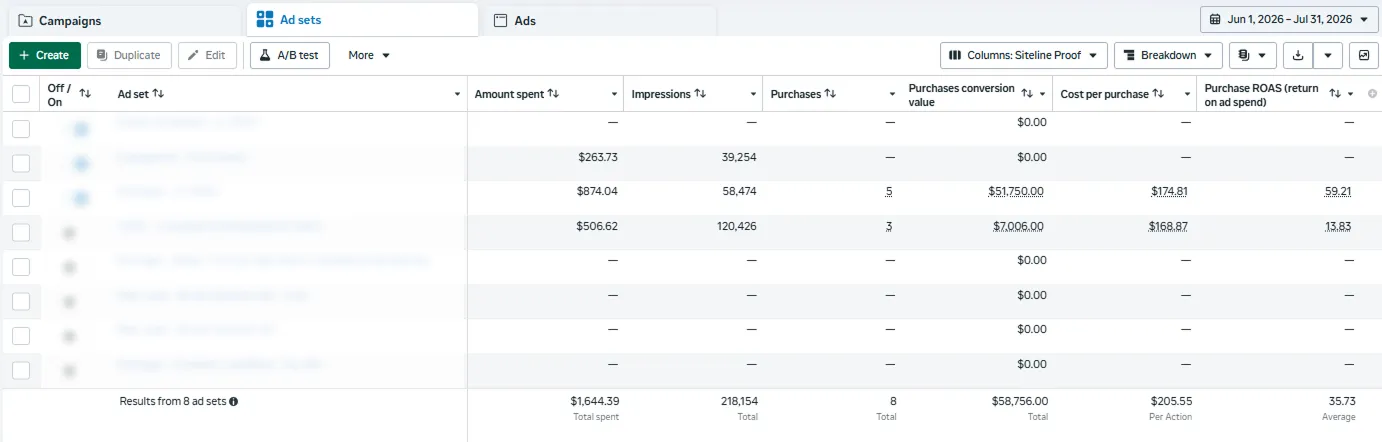
Siteline Deck and Rail, a deck and railing company in Nanaimo, BC, is a Rega client. Its Meta ad account shows what spend against closed work looked like in two windows, stated here as the dashboard shows them. The same account is covered in Facebook ads for deck builders. They are not a forecast, and they are not an average of anything.
1 June to 31 July 2026. $1,644.39 spent, 218,154 impressions, 8 purchases, $58,756.00 in conversion value, $205.55 cost per purchase, and a 35.73 return on ad spend.
17 September to 16 October 2025. 8 ad sets, $900.96 spent, 86,059 impressions, 4 purchases, $42,611.50 in conversion value, $225.24 cost per purchase, and a 47.30 return on ad spend.
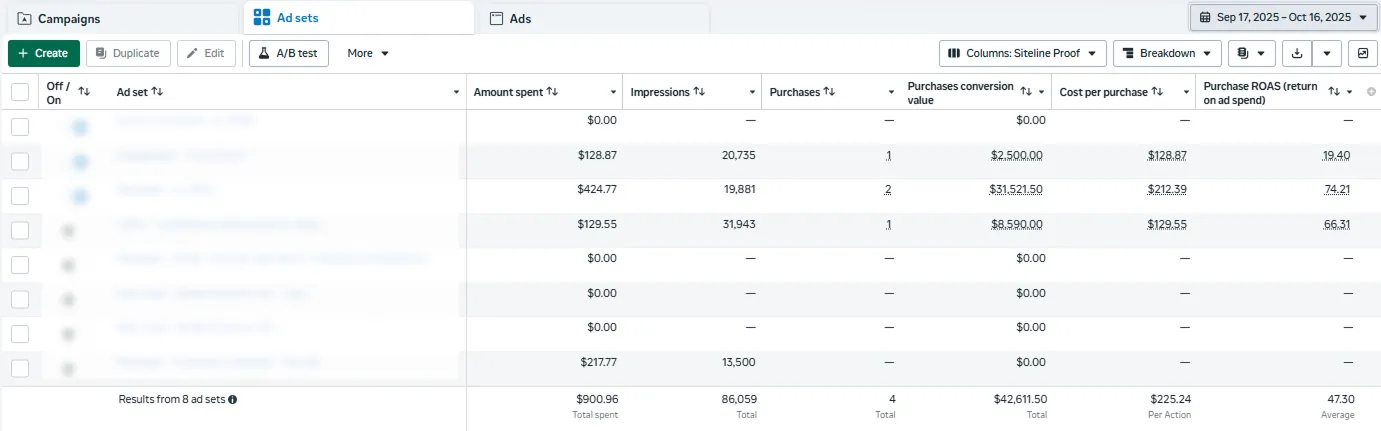
Conversion value here means closed work, not form fills or quotes issued. Return on ad spend is that closed work divided by the spend, so 35.73 means about $35.73 of closed work for each dollar spent in that window.
What do those numbers say about budget?
They say how to think about it, and nothing about what to spend. Dividing the conversion value by the purchases gives roughly $7,345 per purchase in the 2026 window and roughly $10,653 in the 2025 window. That is arithmetic on the captured figures, and it shows the point of this article: a cost of $205.55 to win a job only makes sense because the job is worth thousands.
A business with $1,500 jobs cannot copy that logic. The same cost per job would take most of the job’s value. This is why the job value comes first in the calculation above, and why a figure lifted from someone else’s account tells you very little.
Two limits on reading these captures. They come from one business, in one trade, in a market where the owner answered enquiries and the crew had capacity, and Siteline’s ads ran alongside a built website and a follow-up system. No lead count, sales figure or return is promised here or anywhere on this site, because results depend on your offer, your market and how fast you respond.
Should you start small or spend big?
Start at a figure you can run for long enough to learn something, and raise it only once closed jobs justify it. A budget so small that a month brings three enquiries tells you nothing. A budget so large that you cannot answer the phone tells you less.
The test is whether you can judge it on closed work. Pick a working figure from the calculation above, run it for long enough that a few quotes have had time to be decided, and review which ads produced closed jobs and which only produced enquiries. Raise spend on what closed work, and cut what did not.
Do not raise the budget to fix a response problem. If quotes go out and nobody follows up, more spend buys more unanswered quotes, and it is worth knowing why Facebook leads go quiet. A follow-up system handles that part, with texts that go out when you are on a roof and a pipeline that shows which quotes are still open.
Does a contractor need a website before spending on ads?
You need somewhere credible for the click to land. It can be a simple page, but it has to look like a real company with real work, and it has to work on a phone. Money spent on ads that send people to a thin or broken page is wasted before anyone reads the offer. If yours is not ready, contractor website design is the place to start.
Common questions
Is there a minimum budget? No figure holds for everyone, and we will not invent one. The practical floor is enough spend to get a meaningful number of enquiries in the time you give it, which depends on your market and your job value.
Should I pay a management fee and ad spend together? Keep them separate in your own head. The ad budget is what goes to the platform, and any fee is what you pay for the work of running it. Judge the fee on what the account does, and the budget on the arithmetic above.
Can Rega guarantee how many jobs my budget will bring? No. No one can guarantee results from ads, and we do not. What we can show is the account, the tracking and what each dollar returned in a stated window, like the two above.
How long before I know if it is working? Long enough for quotes to be decided, which for larger jobs is weeks, not days. Judge on closed work over a stated window.
Run the numbers for your own business
Use the ad calculator on our Facebook ads for contractors page with your own job value to see what ads would need to return for your business. It makes no promise about results, and it is the quickest way to tell whether a budget is worth testing.